entry-05
Remote access without opening ports
Adding Tailscale to the homelab for private administration, plus a subnet router so the whole LAN is reachable, with no public SSH anywhere.
revisions rev. 1 first set 2026-10-23 last revised 2026-10-23 2 min read
series / HA DNS part 5 of 9 all parts → ← prev next →
With the DNS stack built and monitored, I wanted to administer it from outside the house without forwarding any ports. Tailscale does that. It builds a private mesh between devices, so the Pi-hole nodes, Proxmox, and my admin machines can all reach each other over an encrypted overlay that never touches the public internet.
The tailnet
Install Tailscale on each device, authenticate it, and it shows up in the
admin console with an address on the 100.64.0.0/10 range.
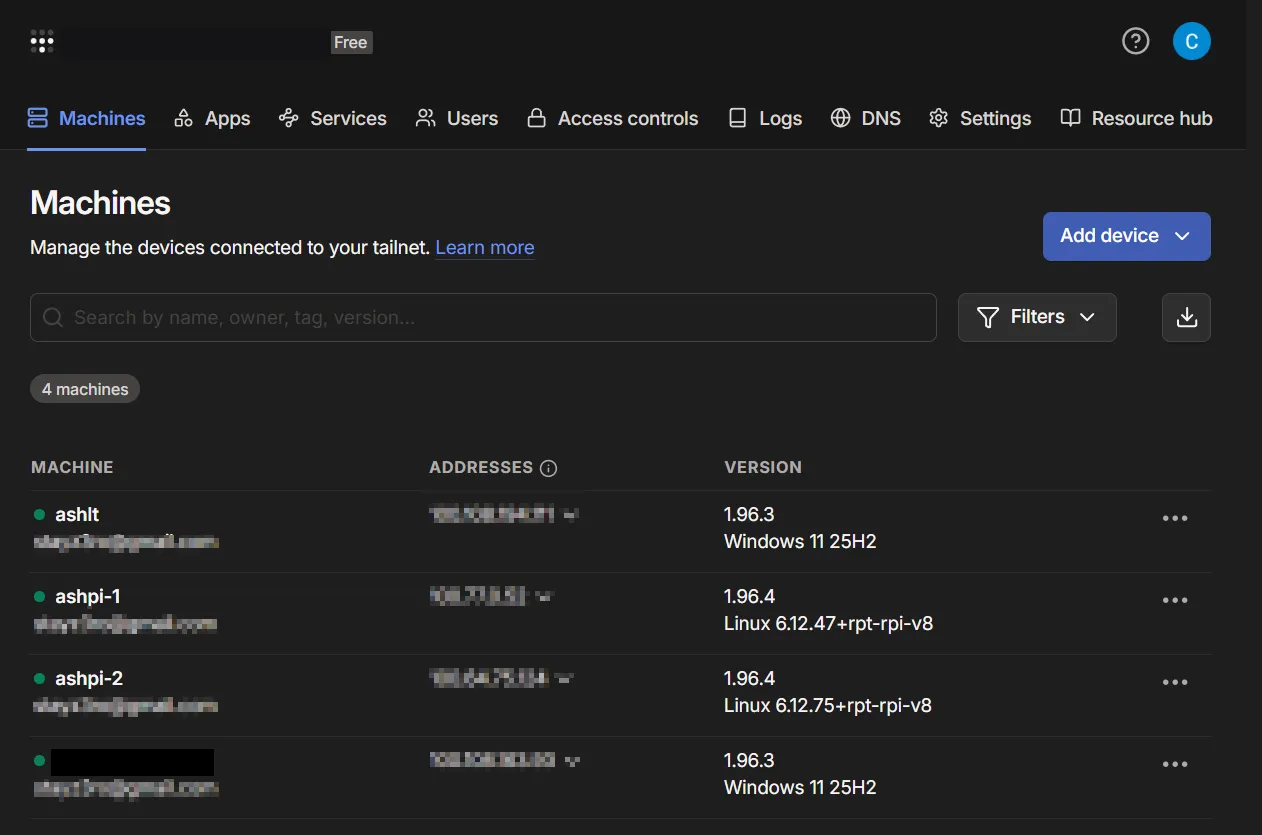
Once the nodes are on the tailnet, SSH to them works from anywhere I’m also on the tailnet, with no port 22 exposed to the world.
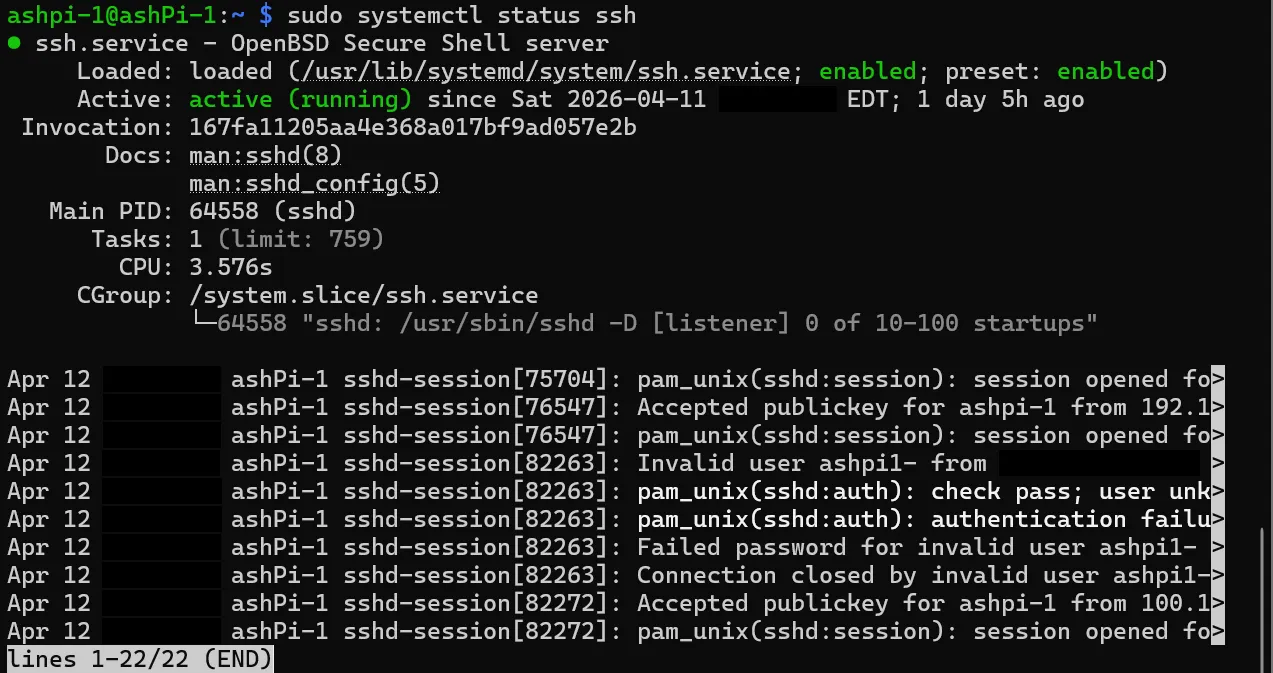
That journal is worth looking at. The accepted logins come in over the
100.x tailnet address. The rejected Invalid user attempts are the
background noise any SSH daemon sees, and none of them get anywhere,
because there’s nothing to reach.
The subnet router
Tailscale connects devices, not networks, by default. To reach a device
on the LAN that doesn’t run Tailscale itself, one node advertises the
local subnet into the tailnet as a route. After that, the whole
192.0.2.0/24 is reachable from any tailnet device, through that one
node.
That covers things like the router’s web UI and the managed switch later, without installing an agent on every box.
The access model
The result is a clean split:
- administration goes over Tailscale, private, encrypted, no public surface
- the services themselves stay on the LAN
- nothing needs a port forward, and there’s no VPN server of my own to patch and expose
This is also the pattern the VPS lab uses later, where SSH is Tailscale-only even though the box is public.
The next phase moved the services off my workstation and onto dedicated infrastructure.
Related posts: Moving services off my workstation and into Proxmox, The standby router that couldn’t tell time, Rebalancing RustDesk and a subnet router across Proxmox nodes.